Sunday, 15 January 2017

HAPPY NEW YEAR! (albeit a bit late).

Welcome to the end of the second week of 2017. How is everyone feeling? Bright and bushy of tail? Or much more scowly and with a thinly repressed urge to punch everyone in the face? This fresh, frigid, brave New Year has taken me, for one, by surprise. I have been sleepy and stumbling about, feeling dazed and unsteady of limb; liverish, odd, in a weird and fuzzy sort of fog. Inertia did set in big time hence no blog until today. There was nothing to do but wait for it all to pass. In the meantime I have nibbled on leftover selection packs, turkey and ham sandwiches, crimble cake, mince pies (they never taste the same do they after Christmas?), while watching old black and white movies, the wonderful musical, "Singin' in the Rain" and other films made in more innocent times.

Just as all New Years - 2017 is no different - have to start on a health kick, here are one or two that could be good for your dog. And I bet they had many a delicious scrap of food fall off the table that's not done their digestive systems any good!

DID YOU KNOW THAT HONEY CAN BE GOOD FOR YOUR DOG?   

Those little bees certainly know a thing or two about the health giving properties of the sweet, gooey stuff that they manufacture. Ive never heard of a bee suffering from coughs and colds or getting the itches, so let's learn a thing or two from them.

Honey is terrific for humans but it is also known to improve allergies in dogs, soothe kennel cough, help dogs' digestive systems and more! There is the argument that raw honey is better than processed honey. The only difference is price and the fact that raw honey is strained to remove debris, but that's it. Yes! of course, processed honey, is manufactured with heat, that thins and dilutes many of its beneficial attributes but having said that, honey is honey and still has magic properties that shouldn't be ignored.

Here are some good uses for giving dogs honey.

Coughs: I have often used diluted honey to cure my dog's cough caused by a collapsed trachea,when she does a late night revolting sounding"Citizen Khan-clearing-of-the-throat" noises.  I make up a solution of teaspoon of honey with warm water to thin it out, a couple of squirts of lemon juice and administer it at the side of the mouth with a plastic syringe (you can get one from the vet). Keep this solution in a small plastic tub and use whenever you need some.  Best to keep it in the fridge as the natural sugar in the honey mixture goes mouldy with a green skin on top if left out at room temperature.  If this happens, just skim off the skin and give the mixture a stir. Its not harmful to the dog.

Itchy skin and feet:  If your dog is allergic to house dust, grass pollen, flea bites or dry skin and is scratching or biting its feet or other parts of its body frequently, giving them some honey twice a day for a week will see an improvement in their symptoms. You can squirt a syringe-ful into their food.

Shampoo:  You can make a watery solution of honey and water and use that as a shampoo but you still have to use a conventional shampoo to wash off the stickiness. The end result is a very soft and shiny coat. (Of course, you can also go the easy route and buy a honey based dog shampoo!)

Next month I will tell you some more useful hints and tips on something totally different for making your dog's life healthier.


Here's an amusing clip of a Husky throwing a tantrum because he doesn't want to leave the park.
                                           
                                          Until the next blog, have an enjoyable January.

                                                               Dawn (."-".)


Wednesday, 30 November 2016

IS YOUR MUCH LOVED POOCH GETTING STIFF AND IN NEED OF A ZIMMER FRAME?

Stiff joints can occur at any age. Is your dog showing these signs of joint discomfort?            
Slowing down, stiffness, or spending lots of time asleep isn’t always down to laziness or being very aged. To achieve healthy, flexible joints some pets just need a little extra support from key nutrients. Soothing the stiffness and helping your pet feel more comfortable can really put the spring back in their step. Below are four top tips to help with joint discomfort.
     
Give your dog short bursts of exercise.  A 10 minutes trot at their own pace does more good than forcing the dog to jog after you or to walk 2 miles. Exercise helps to maintain muscle tone and strength but for an older dog it needs to be less frantic.  The animal needs to sniff the pee mails and read the dog blogs. That stimulation is a form of exercise.
 
Feed your dog less each day to bring down the weight a little. Being overweight, both in people and animals has been shown to give them problems with arthritis and breathlessness.
 
My elderly dog loves her well-padded and warm bed. I am sure all other older dogs probably feel the same about their beds. If they are suffering from any joint pains, it helps to have a soft, comfy bed to crash out in.​ A daily rub down on the sore bits will be very welcomed by your dog.
 
Giving your dog a daily joint supplement will help to ease joint discomfort and stabilise the aching parts. I give my dog a tablet of YuMove in her food plus half a teaspoon of powdered Glaucosamine.  She also gets 6 drops of Abidec, children's vitamins in liquid form and two pillules of Nelson's homeopathic remedy, Rhus Tox, twice a day in her food.  All these things combined have so far helped her arthritis and she is full of energy for a 15 year old.  She can just about run up three flights of stairs with a bit of help from me. Mind you, she does have to build up the puff before she can rush up the first flight.

I bought a hoist  (see pic above) to help her up the stairs when her joints are particularly stiff.  Wrapped around her middle and with handles, it raises her a tad, it makes her feel independent enough to make it up the stairs.
No one has yet made a zimmer frame for elderly dogs but give me enough time and I am sure I will think of something!
******************************************************************************************************                                          Some Trivia........INSECT GENITALIA
Do you remember a few months ago I told you about the exploding dangly bits of ants?
I explained to you how the genitals of a male flying ant explode after mating, and you lot seemed to really enjoy reading about that. So, I thought I'd give you a little update because, as it turns out, ants aren't the only insects to lose their bits in this way – the same thing happens to bees. The queen bee takes flight and, after the fastest male has caught up with her and they've done the deed, the male's genitals and abdomen explode. Tiny bee genital fireworks. Right above your heads. And for that image, you're more than welcome.
***********************************************************************************
 

A MUST HAVE NUMBER TO PIN ONTO THE FRIDGE DOOR.


This is a MUST HAVE number to keep for those middle of the night- scary- emergency moments that can happen when your dog suddenly gets taken ill. How often have you called an Emergency vet to be told that the initial fee will be a gulp- inducing £200 before treatment?  I know someone who has used The Paw Squad veterinary service recently and they were most impressed with the affordable prices, the wonderful way the vet on duty handled the dog and the reassuring calm with which they handled the situation.  And all three vets are ladies.
Your dedicated family vet to look after your pet at home, at a  similar price to a traditional vet visit.
Book an Appointment
Or call 0203 322 1725

£48 Consultation, no call-out fee Evenings & Weekends
Also available for 24/7 support via video or text


Dr Sinead Clancy BSc BVetSci BVM BVS MRCVS


 ******************************************************************************************************

                                             My blog aims to give useful information for dog owners.

My elderly dog hates going to a grooming parlour because of the hot air blower compartments that she has to sit in. She often comes home traumatised and trembling.  I have solved the problem by using a lovely groomer named STEVE, 07931768012.  He comes to the home, brings all his kit, works on the dog, who is relaxed because it is in its own environment with people they know and the end result is a beautifully groomed animal full of the joys of life.
**********************************************************************************
Nothing at all to do with dogs but I thought you would get a chuckle out of seeing this video.

                 Until the next blog, wrap up warm and enjoy scuffing through the fallen leaves.

                                                              DAWN ("^")

Tuesday, 13 September 2016

THE BENEFITS OF GIVING YOUR DOG BREWER'S YEAST

The header picture above is of Candy, my 15 years old Cocker Spaniel. I adopted her 6 years ago. At that time she was overweight, had a shedding dry coat, arthrithic back legs, ears and eyes infections. My husband, Richard and I felt that if she lived for one year or two, it would be a bonus. Since she has been in our lives, I have tried many  different remedies to get her back into shape, and thankfully, she is now back to  her former glory, looking svelte and glossy. Sadly the arthrithis started to worsen this year. 

Several months ago while I was going through a box of old papers and photographs, I came across a piece of paper dated 1966 given to me by a young vet named Bruce Fogel when he was treating my two pomeranians and a miniature long haired dachshund. He prescribed the B-Complex supplements, one of which was Brewer's Yeast. At the time, everyone thought that was a bit.....phwoar!.... what?..... New Age!

I had completely forgotten about the benefits of Brewer's Yeast until a few months ago when I came across the contents of that shoe box.   I  have since introduced a spoonful per meal each day in Candy's food. The change in her mood, coat and  the arthritis in just 6 weeks has been remarkable. She is full of bounce and very lively. It doesn't stop the blindness, deafness or ageing process but it certainly makes the quality of her life much better.

Let me tell you about Brewer’s Yeast. It is a one-celled fungus called Saccharomyces cerevisiae that is used to make beer.  It has also been used for years as a nutritional supplement and an aid in treating some chronic diseases.  (Stay awake please, as I have a little more technical explanation to tell you.)

Brewer’s yeast is an excellent source of Vitamin B-complex, chromium, and selenium.  The B-complex vitamins in this yeast are thiamine, riboflavin, niacin, pantothenic acid pyridoxine, folic acid, and biotin.  It doesn't have Vitamin B12 that is found in meat and dairy products. However, if you want energy, sparkling eyes and a nice shiny hairy coat then Brewer's yeast is perfect for you. Its also terrific for your dog!

If your dog is pudgy then you can help it to lose some weight by sprinkling a teaspoon of Brewer's Yeast on its food twice a day. It works well in weight loss by helping reduce body fat, although  nothing beats exercise and feeding smaller portions for the best results.  Brewer’s yeast is a good source of protein and gives an energy boost.  I would recommend Brewer’s Yeast for  dogs with weak stomachs, andfor  those who have the "runs" at the drop of a hat.

Experience has shown me that Brewer’s Yeast is a great antioxidant and that applies to dogs as well as humans.  By supplementing your dog’s diet with Brewer’s Yeast, the coat will be healthier and shed less. It will also help boost the immune system that will keep off ticks, fleas and  anything else that takes refuge in your dog's fur. The selenium in the Brewer's yeast is good for the heart.

Candy, my 15 year old Cocker spaniel is arthrithic and it was obvious that her her back legs were painful in wet weather. Since giving her Brewer's yeast, she has taken on a new lease of life and is full of bounce - even chasing a ball in the park!

If your dog is stressed, nervous or suffering separation anxiety, Brewer’s Yeast will calm them down. The reason for the calming effect is the good source of vitamin B-complex. B vitamins are depleted rapidly when the dog is stressed or nervous. By adding a good source of vitamin B-complex, like brewer’s yeast, to the diet, it lessens the symptoms of separation anxiety,

Brewer’s Yeast smells good and tastes yummy to dogs. If your dog is a finicky eater or getting over an illness, add brewer’s yeast to the food.
Some folks are concerned about giving any yeast to a dog with yeast infections. The yeast you are feeding your dog is not the same as the yeast infection in the ears or skin. 
Overall, Brewer’s Yeast is safe and beneficial. Don’t get it confused with other dietetic yeast out there. Baker’s yeast, nutritional and torula yeasts, are tpes of yeast that are low in  nutrients such as chromium and selenium.

Brewer’s Yeast is a safe and beneficial supplement. It varies in price according to the manufacturer but I have found the best one to be from Holland and Barratt. You can get a large  pack of powdered Brewer's Yeast online  or instore from Holland and Barratt.  Its a  definitely a good supplement to add to your dog's food. Did I mention that fleas find the taste repellent?  I have not had to use Frontline or other chemicals to keep the ticks and fleas at bay since giving on Candy, my cocker spaniel a teaspoon of Brewer's Yeast in each meal.

On a personal level, I too, take Brewer's Yeast to stop the 'mozzies' making a meal out of me. One bite and its bleurgh!  As for keeping the fleas at bay, I can honestly swear, hand on heart, that I haven't yet had fleas!

Trivia...............

It's September. Summer is officially winding down. Which is weird because it feels like only yesterday that we were planning weekends filled with country walks, picnics on the seafront and Santander bike rides in the No Cycling part of the park. To make sure we're making the most of the last few weeks of British summer, here are a few things to tick off before the sun goes in:

Put away those shorts that only saw the light of day twice
sleep with duvet under 10 tog
leave house without backup jumper
eat swirly ice cream in a cone with a flake and sprinklies on top before they stop selling it
eat more than three Magnum lollies
leave house without backup umbrella
eat food anywhere without a roof 

take to the woollie hat to keep your head warm 
                                 ********************************************

Here's a clip of a cockatoo throwing a tantrum.  I know many people who behave like this!


                                               That's it for this month's blog. The next one will be in October. 

                                                                                    Dawn  (-,-)*

Saturday, 6 August 2016

ANY IDEA WHAT A PROBIOTIC IS AND WHAT IT DOES?    


The big buzzword that we've all seen plenty of lately is "probiotic". You've probably seen or heard this word in advertising and in magazines for both dog food and human products and wondered if you should give it a go.  Is it another one of those hippie dippy things that the knit-your-own-muesli brigade go on about? What do they do? Do they really work for  the digestive system?  You bet they do!  I've used probiotics for myself and for my dogs for many years, when we have experienced tummy problems.  Yes! I was considered quirky at that time because people had never heard of probiotics, let alone used them but in my opinion, they are the magic formula for curing all stomach ails.

The most common reasons  I would recommend probiotics for dogs are for runny tums, garbage gut, throwing up and generally feeling out of sorts.  When my dogs start  messing on the carpet, kitchen floor or feverishly chomping on grass then throwing  up white froth, I think "uh! oh! the next step is up-chucking in the car or on the carpet".  That's when I give them a tablespoonful of plain yoghurt, or one of those probiotic drinks such as Actimel or Yakult. They lap it up and never turn up their noses as they do with food. Many dog product mnufacturers have now jumped on the band wagon and you can get probiotics in powders, capsules and liquid form from pet shops and online.

Probiotics are as timeless as paleolithic man with their soured mammoth milk, yet these therapeutic food additives are a relatively new modern way of taking care of your  and your pet's digestive system.

How are Probiotics Formulated?
Just so that you know, probiotics are usually formulated as oral supplements from health food shops. Some come as capsules, or as tasty chews. Others are powdered and packaged either in single-dose envelopes or sold in multi-dose containers. Many others are included in dog foods marketed "for intestinal health." The most commonly used probiotic is plain yoghurt or those highly priced little bottles of Activia, Yakult and other milky drinks on the supermarket shelves.
Probiotics are live micro-organisms, that when administered regularly give a health benefit to the user, be it human or animal.

The idea is that by adding "good" bacteria, this will stimulate the production of more beneficial bacteria (the good ones that are presumed to be associated with specific health benefits). In this way, the entire balance of the intestinal flora will be shifted toward the beneficial bacteria.  Sounds a bit New Age but there are good and bad germs in the gut and the probiotic taken daily helps to keep the bad buggies at bay.

Which begs the question: Should your dogs be taking these supplements? Yes! absolutely. Without any doubt. You should be giving your dog probiotics.  Many people will whinge that its too much hassle but a little drop each morning in a dish before walkies will set your pet up and help with that garbage foraging. Then they can come home and enjoy breakfast.  Its a win-win situation. Give your dog a daily probiotic drink or powder and you will not have to clear up at unexpected moments.  Probiotics are also excellent for dogs that have a very delicate stomach. You know the ones that have  a special veterinary diet. Its helps them along. I can hear you asking: "What, no drugs, no side-effects, and you say my dog will do even better than on some of the other stuff? Sign me up!
So the next time your dog is out-of-sorts, give them yoghurt or a probiotic  drink. It settles the stomach.

Some trivia  to mukk over ....................

wonderful sounding words to describe something:
Other countries have brilliant words for things that we just don't have words for in English. My favourites include 'backpfeifengesicht' which means 'a face badly in need of a fist' in German, and the Norwegian word 'palegg', which means 'anything and everything that you can put on a slice of bread'.  Another of my favourites is 'Floopy Azucar' which is a sugared ring doughnut in german/spanish that is sold in the bread section of Lidl stores everywhere but in the UK.
Here are a few other things we reckon deserve words of their own:

1. The urge to touch something you've already been told is really hot.
2. The desperate desire to share gossip you've been told you absolutely can't repeat.
3. The feeling of being really, really full but not too full for dessert.
4. The desire to make the first page of a new notebook absolutely perfect.
5. The brief window of time when an avocado is perfectly ripe.

Here's something different ..... clip of a bird force feeding a cat and a dog! (Thanks to David Howells - impressario, entrepreneur, music mogul - for finding this little gem).


            That's it for this month.  Hope you found the information useful and interesting.
                                                                Dawn  (**)


Monday, 4 July 2016

DOES YOUR DOG SUFFER FROM ADHD? (Attention deficit hyperactivity disorder)

Many people complain that their dog is so hyper-active that it seems to spend its time in the house bouncing off the walls and furniture, tearing up anything it can find, getting into everything, despite having had a free range, long walk in the walk in the mornings and a shorter sniff-around in the evenings?  They feel at their wit's end not knowing how to control the situation.

Some dogs do suffer from attention deficit syndrome but this is largely due to teenage puppyhood. From six months to a year, most dogs need a lot.... and I mean .....a lot of mental stimulus.  This means letting them sniff every lamp post, tree, railings, walls and anything else that comes within 1" of their noses.  A walk doesn't mean dragging them behind you for a jog. It means letting them sniff the pee-mails left by other dogs. This is information gathering that they can take home and think about who left that scent marker. Sometimes their brains go into stimulus overload and they have twitchy, running along dreams.

The meanest thing that an owner can do is to refuse to let the dog sniff around on a walk.  So often the dog gets pulled away from everything and in many cases, ill-informed owners think that by dragging a dog behind them tied to a bicycle or as they jog is exercise.  Forcing a dog to run behind you is a sure recipe for a cruciate ligament injury at some stage in the dog's life. And as for being tied to a bike. Isn't that almost as bad as tying it to the back of your car and dragging it along? Both these activities can cause cruciate ligament injuries because of the strain put on the dog's legs.  You think I am talking out of my hat and you don't believe me! I'll bet you know someone, who knows someone, whose dog had a leg injury through being made to run behind the owner.
                                               *****************************
Did you know.......now that we are into Wimbledon, my predictive powers tell me that the newspapers will tell us that:
1.    Andy Murray's tennis skills, body language and smiling capabilities will come under close scrutiny.
2.    We will be told how many tennis courts could be filled by the amount of strawberries and champagne people have    consumed/quaffed.
3.    Pippa Middleton has been spotted in the crowd and her face will appear on screen as much as the tennis.
4.    Sue Barker, John McEnroe and John Lloyd are still around and saying things. 

5.   A competition will be held to see who can make Ivan Lendl crack a smile?

Thursday, 2 June 2016

DO DOGS HAVE ROLE MODELS AND HEROS?
You bet they do!  Take a look at this picture of two of my good friends, Roddy the labrador and Ernie, his adorable puppy companion.  Doesn't that look say "My hero?!"

When Ernie first joined the household, Rodney would get up and move away rather than be near him. His eyes would be pleading "I hate him. He stinks. He pees everywhere. He steals my bed, treats and food. Give him away please! PLEEZE! I will do anything that you ask, just get rid of him." After one month, they became best mates and are now inseparable. Roddy is very tolerant and lets Ernie share his bed, steal his food, treats and be first for the cuddles. There is not an ounce of resentment or jealousy.
Dogs are hard-wired from puppyhood to sharing space with other dogs. They learn to follow their lead and mimic their actions.  This  mimicking behavior shapes the learning ability of dogs, especially during puppyhood. An older dog becomes their hero and role model in life. Roddy defends Ernie the moment another dog comes near him.
Look and Learn
Dogs learn far more quickly by observing others than by trying to do it on their own. Owners of adult dogs are often shocked by how easy training becomes when taking in a new puppy. The pup comes when called by mimicking and following his adult companion. The new addition watches as the mature dog sits on command, and learns the trick with less training. More complicated tasks can also be learned when one dog watches another (such as walking down a staircase or swimming) through simple demonstration and mimicking.
Something New
While their ability to learn from each other is quite remarkable. Dogs not only learn by copying, they also have an uncanny human-like ability for “selective imitation.” This means canines don’t just possess the ability to copy other dogs’ actions, but to selectively copy, based on the circumstances. In other words, they only mimic each other’s behavior when they think it’s the most efficient way to get something done. The older dog does become the hero and role model in later life.
The Flip Side
Understanding dogs’ ability for selective learning also reveals why they sometimes make choices we don’t approve of. Let’s go back to the example of a new puppy joining the family dog. While it’s true the junior party in this equation is likely to follow the senior to the garden and “go” with them, it’s also true that the puppy will copy bad behaviour.
Many owners get nervous about replacing a dog with a new one when there is an established dog in the household. Stop worrying! The older dog will not harm a puppy. For the first few weeks it will be begging you with its eyes "Please give it away. I don't want it following me around and bugging me." It will snarl, growl and snap at the puppy but it will be the same sort of behaviour that  an elderly person displays who think children are a total pain. An older  dog will never, ever kill or harm a puppy. The moment someone or another dog threatens the puppy, the older dog will leap to its defence. From that moment on, that puppy becomes their puppy. Puppies can and do learn bad behaviour as well. One example would be the new puppy watching wide eyed as the established dog opens the cupboard to retrieve a treat for themselves, or sees the adult dog run wild as soon as it is off its leash. Although a punishment from their human may come later, there are immediate rewards that the new puppy experiences first. It is very gratifying seeing a puppy following their hero everywhere and learning how to cock its leg for a pee just like its hero and role model.  If you have a puppy, let it learn dog behaviour by taking it to puppy training classes and by setting up "puppy play days" with older dogs.
                **Here is a fun, doggy event that might interest you.http://dogfest.seetickets.com/tour/dogfest**                                   

                                                  Enjoy this wonderful clip of the power of "elephant road rage"  
                                                                               Dawn ("")

Friday, 1 April 2016


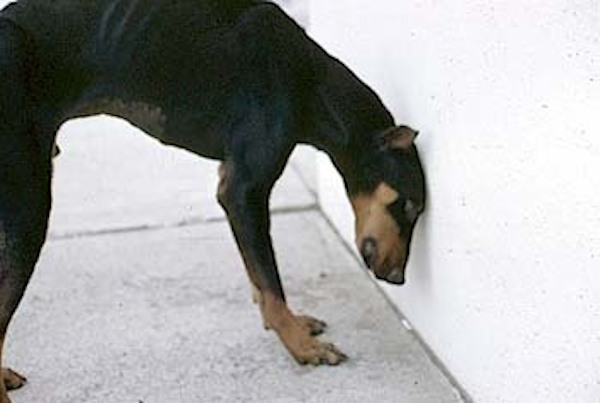
THIS IS AN EMERGENCY! IF YOU EVER SEE YOUR DOG DOING THIS, TAKE IT TO THE VET IMMEDIATELY.


Head Pressing is a medical emergency. If you see your pet exhibiting this behavior, you should seek veterinary attention immediately.  No Ifs...... Buts......... or Maybes. Immediately! Everyone should know about this, please read and share this blog.

Quite often, when a dog or cat owner initially sees this behavior, they may not know how to interpret it. At first, they think that Head Pressing,  is just their dog being silly, or playful or they will say "Poor thing! its got a headache!". That maybe the case, with but any abnormal behaviour to do with the head, it is critical to be able to recognize this behavior for what it is. So the question is, what conditions could this potentially indicate? The answer isn’t a simple one, but here are some of the potential causes of Head Pressing:
  1. Tumors located near the skull and brain of the animal.
  2. Toxins being introduced into the system (Lead, for example) that is causing liver/kidney failure.
  3. A Metabolic disorder.
  4. Acute Head Trauma.
  5. Stroke.
  6. Brain Tumour
head-pressing-labrador
From the severity of these potential causes, you can see why it is incredibly crucial to get your animal to a vet immediately. Most of these causes affect the animal neurologically. That being said, while head pressing may be one of the most blatant symptoms, a pet owner should also be aware of other behaviors that could indicate these serious underlying issues, such as:
  1. Walking In Circles
  2. Pacing Around Anxiously and Aimlessly
  3. Seizures
  4. Irregular Reflexes
  5. Visual Impairment
  6. Abnormal aggression, ie suddenly turning on you.
head-pressing-doberman
What I am relating is first hand knowledge of this behaviour.  Two dogs who were staying with me at different times demonstrated this behaviour. The first one we saved in the nick of time with the help and expertise of the Elizabeth Street Emergency Clinic and the Veterinary College in Potters Bar and the second one, I'm afraid had a series of seizures at 2 'o clock in the morning and hung on long enough to  get her to the vet and say goodbye to her mum.  One had a brain tumour and the other needed emergency surgery for a liver shunt to be fitted to stop him being poisoned by the toxins in the dog food.

I don't mean to be alarmist but when I see this behaviour from a dog in the park and I mention it to the owner, they respond with "Oh! he always mucks around like that, even at home."  Sadly, they will find out when its too late.


This and that ...............

With all the building work going on in the street that I live on, I have had an infestation of mice for 2 years. We have tried everything and still they come. In desperation, I decided to try those electromagnetic rodent plug- in gizmo's.  Before I placed the order, I logged onto a site and asked the question "Do they work?" and got this wonderful response from someone in the world.

"I purchased the electronic pest repeller and plugged it in. It says its good for rodents and other insects. Haven't had a mouse in my house but  later in the day I saw a cockroach, grabbed the electronic pest repeller out of the wall socket and smashed the cockroach with it. The cockroach was deffinately(sic) dead. The device was 100% effective, and the easy storage in electrical outlets makes it handy. I’m going to purchase one for every room in my house. I can't tell you if it has any effect on mice".
                                                 Thought for the day


Dogs won't ever wake you up in the middle of the night to ask: "If I died, would you get another dog?"

                                
                                                A  clip to make you smile!

 That's it for the April blog. Pass it around to your doggy loving friends.   Next blog in May . 
                                                        Dawn ("^")

IF YOU EVER SEE YOUR DOG HEAD PRESSING, YOU SHOULD TAKE IT TO THE VET IMMEDIATELY. THIS IS AN EMERGENCY.  SEEING THEM DOING THIS IS AN EMERGENCY.

if you ever see your dog doing this action, take them to the vet as it is an emergency situation.  The reason wil shock you.